
It's Not Willpower. It's Glutamate.
NAC is the only compound with a published clinical trial in Archives of General Psychiatry showing 56% of trichotillomania patients much or very much improved. It works by restoring glutamate balance in the brain region that drives compulsive behavior. Your SSRI targets the wrong neurotransmitter. This targets the right one.
Shop Now — 90-Day Guarantee
Your SSRI Targets the Wrong Neurotransmitter
Trichotillomania is not an anxiety disorder. It's a glutamate disorder. SSRIs target serotonin — and published research confirms they don't reduce hair pulling. NAC targets glutamate — the neurotransmitter that actually drives the urge.
Glutamate Modulation — Quieting the Urge at Its Source
The urge to pull is driven by excess glutamate in the nucleus accumbens — the brain's habit and reward center. That excess creates a neurochemical "pressure" that builds until pulling releases it. NAC restores extracellular glutamate concentration in this region, reducing the pressure so the urge becomes resistible. Not through willpower. Through chemistry. This is the same mechanism that makes NAC effective in substance abuse disorders — it addresses compulsive behavior at the neurotransmitter level.
Published in Archives of General Psychiatry — 56% Improved
Grant et al., 2009. University of Minnesota. 50 adults with trichotillomania. Randomized, double-blind, placebo-controlled. 12 weeks at 1200-2400mg/day. Result: 56% of patients were rated "much or very much improved" — versus 16% on placebo. 40.9% mean reduction on the MGH Hair Pulling Scale. Published in one of the most prestigious psychiatry journals in the world. No other pharmacological intervention for trichotillomania has produced results this strong.
Works Alongside Therapy — Not Instead of It
CBT and Habit Reversal Training address the behavioral layer of pulling — awareness, competing responses, trigger management. NAC addresses the neurochemical layer — the glutamate imbalance that creates the urge in the first place. The study's own authors recommend: "Cognitive Behavior Therapy should be considered in conjunction with pharmacotherapies." Both layers addressed is stronger than either alone. If you're in therapy, NAC is the complement your therapist can't prescribe.


3,000+ Happy customers
NAC — Glutamate Support for Compulsive Urges
glutamate balance
clinical trial
improved
Couldn't load pickup availability
Feel the difference in 60 days or your money back
60-Day Guarante
60-Day Guarante
We offer a 60-day money-back guarantee.
If for any reason you're not completely satisfied with your purchase, we'll issue a full refund, no questions asked. Simply reach out to our support team for assistance.
Shipping & Returns
Shipping & Returns
We offer tracked shipping on all orders.
All orders are processed by our careful fulfilment team within 24 business hours.
We are currently experiencing high volume of orders so delivery times, depending on your location, range from 5-13 business days.
We've made returning products super easy. Simply contact us info@loominutrition.com and we'll handle
Is It Safe?
Is It Safe?
Yes — our Black Seed Oil supplement is 100% natural, non-GMO, vegan, and made without any artificial fillers or preservatives. All ingredients are third-party tested for purity and potency in a GMP-certified facility.
Ingredients
Ingredients
Black Cumin Seed Oil (Nigella sativa)
Standardized to 2% Thymoquinone (TQ)


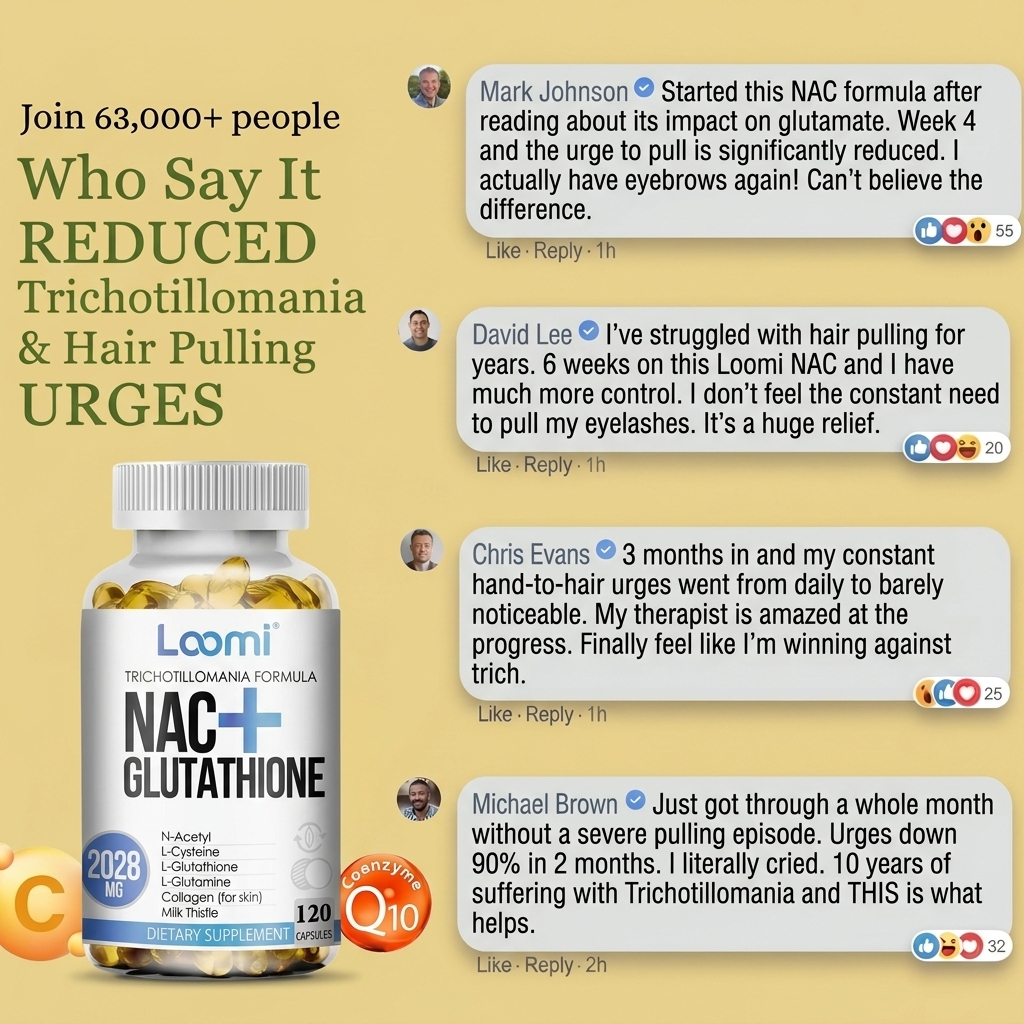
From the Trich Community
The Urge Got Quieter.
Real experiences from people with trichotillomania who added clinical-dose NAC to their routine.
"I've pulled since I was eleven. I'm 28 now. Seventeen years. I tried Zoloft for a year — it helped my anxiety but the pulling didn't change at all. When I read that SSRIs target the wrong neurotransmitter for trich, everything clicked. Started NAC at 1200mg twice daily. By week 9 I noticed I was watching TV without my hand drifting to my eyebrows. By week 12, I'd gone five consecutive days without pulling for the first time since middle school. The urge isn't gone. But it's quiet enough that I can choose not to."
"I tried NAC a year ago and it didn't work. Then I read that the clinical trial used 1200-2400mg and the improvement didn't show up until week 9. I had been taking 600mg for four weeks. I was using the wrong dose for not long enough. Restarted at the clinical dose. Committed to 12 weeks. By week 10 my therapist noticed a difference before I did — she said I was describing the urges differently. Softer. Less urgent. I stopped fighting a storm and started managing a breeze."
"Postpartum trich flare destroyed my eyelashes. I was too ashamed to leave the house without false lashes. My therapist recommended CBT, which helped me notice the pulling. But the URGE was still there — I was just aware of it now. She suggested adding NAC for the chemical side. Within 8 weeks the urge softened enough that the CBT techniques actually worked. I have real eyelashes for the first time in two years."
Made for the Urge You Can't Explain
Clinical-dose NAC backed by published research in one of the most prestigious psychiatry journals in the world. No FDA-approved medication exists for trichotillomania. This is the closest thing to one.
Published RCT
Archives of General Psychiatry, 2009. 50 patients. 56% improved.
Glutamate Modulator
Targets the neurotransmitter that drives compulsive urges. Not serotonin.
Clinical Dose
Matched to the dose used in published research. Not underdosed.
Works With Therapy
Complements CBT and Habit Reversal Training. Both layers together.
What to Expect
NAC works by gradually rebalancing glutamate in the nucleus accumbens. This isn't instant — it's a neurochemical recalibration that takes weeks. The clinical trial showed significant improvement beginning at week 9. Here's the typical timeline.
Weeks 1-4: Building
NAC begins restoring extracellular glutamate balance. You may not notice obvious changes yet. The chemistry is shifting underneath. Don't judge results during this phase.
Weeks 5-8: Softening
Many users report the urge becoming "quieter" — not gone, but less insistent. The tension that builds before pulling starts to peak at a lower level. Some days pass without pulling before you realize it happened.
Weeks 9-12: Measurable Improvement
This is when the clinical trial showed statistically significant results. 56% of patients were rated "much or very much improved" at week 12. Pull-free days increase. The compulsion becomes resistible in a way it wasn't before.
Month 4+: Ongoing
Continue at the same dose. Many users report continued improvement beyond 12 weeks. Combine with behavioral strategies (CBT, HRT, awareness tools) for strongest results. The NAC addresses chemistry. The therapy addresses behavior. Both layers.
Questions
Everything You Need to Know
SSRIs target serotonin — the neurotransmitter associated with mood and anxiety. Trichotillomania is driven by glutamate dysregulation in the nucleus accumbens — the brain's habit and compulsion center. Published research confirms SSRIs show "no significant differences in reducing the urge to tear hairs" compared to placebo for trich specifically. Your SSRI may help your anxiety. It doesn't address the pulling because it's targeting the wrong neurotransmitter. NAC targets glutamate — the one that drives the compulsion.
Two questions: What dose did you take? And how long did you take it? The clinical trial used 1200-2400mg per day for 12 weeks. Significant improvement didn't appear until week 9. If you took 600mg for 4 weeks, the glutamate rebalancing was incomplete — you stopped before the mechanism had time to work. This product provides the clinical dose. The 90-day guarantee gives you the full evaluation window the research shows is necessary.
NAC works on the glutamate system. SSRIs work on the serotonin system. They operate on different neurotransmitter pathways. NAC has been studied as an add-on therapy alongside existing psychiatric medications. That said, always discuss with your prescribing psychiatrist or doctor before adding any supplement to your regimen.
We want to be honest: 56% of patients in the clinical trial were much or very much improved. That means 44% did not respond. NAC is not a cure. For those who do respond, the effect is typically a significant reduction in the intensity and frequency of urges — the pulling becomes resistible in a way it wasn't before. Combined with behavioral strategies (CBT, Habit Reversal Training), the results are strongest. It addresses the chemistry. Therapy addresses the behavior. Both layers.
Yes — a separate clinical trial tested NAC in 66 adults with excoriation disorder (skin picking). 47% improved versus 19% on placebo. The mechanism is the same: glutamate modulation in the nucleus accumbens. All body-focused repetitive behaviors (BFRBs) — hair pulling, skin picking, nail biting — are driven by the same neurochemical pathway. NAC addresses the pathway, not the specific behavior.
The adult clinical trial showed strong results. A pediatric trial (ages 8-17) did not show significant improvement. Researchers believe this may be because children and adults have fundamentally different pulling patterns and neurochemistry. That said, individual case reports in teenagers have shown positive results. If you're considering this for a teenager, discuss with their pediatrician or psychiatrist first.
NAC was well tolerated in the clinical trial. Reported side effects were mild: occasional nausea, indigestion, or headache. No significant adverse events. NAC has an extensive safety profile — it has been used for decades as a pharmaceutical (mucolytic for cystic fibrosis, antidote for acetaminophen overdose). The safety data is one of the strongest of any supplement.
90-day money-back guarantee. We specifically chose 90 days because the clinical research shows improvement takes 9-12 weeks. We want you to have the full window to evaluate properly. If it doesn't help, full refund, no questions asked.
"I've been pulling since I was thirteen. I'm thirty-one now. Eighteen years. I tried Zoloft, Lexapro, CBT with two different therapists, fidget toys, rubber bands, awareness bracelets, and a HabitAware device. Everything helped a little. Nothing quieted the actual urge. When I read that SSRIs target serotonin and trich is a glutamate disorder, I felt like someone had finally explained why nothing had worked. I started NAC at the clinical dose. By week ten, the urge was still there but it was softer — like turning the volume from 9 down to 4. I could choose not to pull. For eighteen years I couldn't choose. Now I can. That's the whole difference."

The Compound Your Psychiatrist Wasn't Trained to Mention
N-Acetyl Cysteine has been used in medicine for decades — as a mucolytic for cystic fibrosis and as the antidote for acetaminophen overdose. Its safety profile is one of the most established of any compound in clinical use.
In 2009, Dr. Jon Grant at the University of Minnesota published a landmark study in Archives of General Psychiatry demonstrating that NAC significantly reduced hair-pulling symptoms in adults with trichotillomania. The mechanism — restoring extracellular glutamate balance in the nucleus accumbens — offered the first neurochemical explanation for why SSRIs fail in trichotillomania and why a glutamate modulator succeeds.
No FDA-approved medication exists for trichotillomania. NAC is the closest thing to one — and it's available over the counter.
"This study, the first to our knowledge that examines the efficacy of a glutamatergic agent in the treatment of trichotillomania, found that N-acetylcysteine demonstrated statistically significant reductions in trichotillomania symptoms."
— Grant, Odlaug, & Kim, Archives of General Psychiatry, 2009
You're Not Weak. Your Glutamate Is Imbalanced.
The Urge Has a Chemistry. The Chemistry Has a Solution.
Clinical-dose NAC. Matched to the published research. The only compound with a positive randomized controlled trial for trichotillomania. Works alongside therapy. No sedation. No weight gain. No sexual side effects. The layer your SSRI was never designed to reach.
Shop Now — 90-Day GuaranteeQuieter Urges. More Pull-Free Days.
Real people with trichotillomania. Real results.

"Scalp pulling since age 9. I'm 34. Twenty-five years. Had a bald spot the size of a silver dollar on the back of my head that I covered with strategic hairstyles every morning. Three months on NAC at clinical dose — the spot is growing in for the first time. Not because I forced myself to stop. Because the urge got quiet enough that I just... didn't. My hairdresser asked what changed. I told her I finally found the right neurotransmitter."

"Eyelash puller. Spent $800 a year on magnetic lashes. Tried two SSRIs, CBT, and a HabitAware bracelet. The bracelet helped me notice. The CBT taught me techniques. But the URGE was still screaming underneath all of it. NAC turned down the scream. By month three I had real lashes long enough to see when I looked in the mirror. I cried. Not from shame for once. From relief."
*These statements have not been evaluated by the Food and Drug Administration. This product is not intended to diagnose, treat, cure, or prevent any disease. Results may vary. Individual response to NAC varies — the clinical trial showed 56% of adult participants improved, meaning 44% did not respond. This product is not a replacement for professional mental health treatment. Consult your healthcare provider before starting any new supplement, especially if you are currently taking prescription medications. The clinical trial referenced (Grant et al., 2009) was conducted in adults; a pediatric trial showed different results. If considering for a minor, consult with their physician.