
You Got "Dust-Free" Litter.
Your Cat Still Coughs.
Dust is only one of three things your cat inhales at the litter box. Ammonia gas and toxic VOCs are the other two. No litter fixes those. This purifier catches all three at the source.
Protect Your Cat →
Three Toxins. Six Inches From Her Face.
Silica Dust
Clay litter kicks up carcinogenic silica particles every time your cat digs. "99% dust-free" still means silica goes airborne.
Ammonia Gas
Cat urine breaks down into ammonia. Reaches 15 ppm in 10 days. Your cat smells it before you do. It burns lungs.
Fecal VOCs
Methyl mercaptan, skatole, hydrogen sulfide. That "cat smell"? Those are toxic volatile compounds from feces.
Your AC Spreads Fumes Everywhere.
Ammonia and VOCs are gases. They rise, get pulled into your air vents, and your HVAC pushes them into every room. That faint "cat smell" in your bedroom? It traveled through your ductwork.

Fumes travel through vents to every room

Fumes caught at the source before they spread
Capture at the source. Before it reaches the vent. Before it reaches every room.
Common Solutions Fix the Box.
None Fix the Air.
"Dust-free" litter — doesn't touch ammonia or VOCs. One of three problems.
HEPA purifier — catches dust, not ammonia. Ammonia is a gas. It passes right through.
Litter Robot — solves scooping. Fumes were airborne before it cycled.
Covered box — traps ammonia INSIDE. Your cat breathes more, not less.
Febreze / candles — masks smell with more chemicals. Another trigger.
The problem was never the litter. It was the air AROUND the litter. Your cat gets sick from breathing above it.
Three Layers. Three Toxins.
Caught at the Source.
Zeolite Catches Ammonia
HEPA can't catch ammonia — it's a gas, not a particle. Zeolite is a natural mineral that chemically binds ammonia molecules and pulls them from the air. This is the layer your air purifier doesn't have.
Carbon Catches VOCs
Activated carbon adsorbs the toxic compounds from feces onto its surface. Not masking. Removing. The "cat smell" is physically pulled from the air.
Filtration Catches Silica Dust
Carcinogenic silica particles caught inches from where they're kicked up. Not 8 feet away after your cat already inhaled them.


1,800+ Cat parents trust it
Litter Box Air Purifier — Negative Ion Technology · Decomposes Harmful Gases
harmful gases
quiet
no scent
Couldn't load pickup availability
Feel the difference in 60 days or your money back
60-Day Guarante
60-Day Guarante
We offer a 60-day money-back guarantee.
If for any reason you're not completely satisfied with your purchase, we'll issue a full refund, no questions asked. Simply reach out to our support team for assistance.
Shipping & Returns
Shipping & Returns
We offer tracked shipping on all orders.
All orders are processed by our careful fulfilment team within 24 business hours.
We are currently experiencing high volume of orders so delivery times, depending on your location, range from 5-13 business days.
We've made returning products super easy. Simply contact us info@loominutrition.com and we'll handle
Is It Safe?
Is It Safe?
Yes — our supplements are 100% natural, non-GMO, vegan, and made without any artificial fillers or preservatives. All ingredients are third-party tested for purity and potency in a GMP-certified facility.


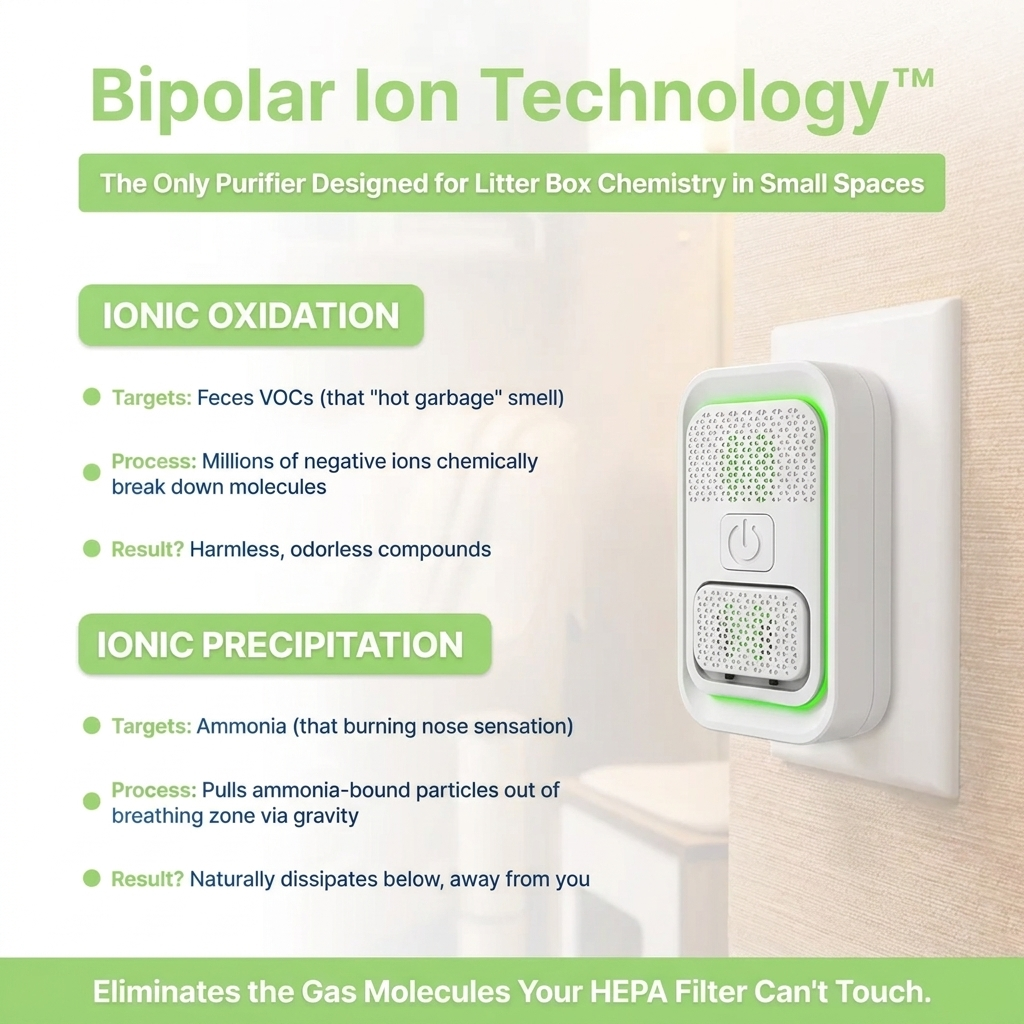
Three Filtration Layers.
Three Toxins Captured.
Each layer targets a specific contaminant your current setup is missing. Not a HEPA. Not a fragrance. A targeted system designed for cat litter emissions.
Zeolite — Captures Ammonia Gas
A natural mineral with a crystalline lattice that chemically binds ammonia molecules on contact. This is the layer HEPA purifiers don't have — ammonia is a gas (0.0001 microns), not a particle, and passes right through HEPA filters. Zeolite is the only commercially available medium that reliably captures ammonia from air.
Activated Carbon — Captures VOCs
A single gram of activated carbon contains up to 3,000 square meters of internal surface area. VOCs from feces (methyl mercaptan, skatole, hydrogen sulfide) adsorb onto this surface. Not masking. Molecular capture. The odor compounds are physically removed from the air.
Particulate Filtration — Captures Silica
Crystalline silica particles captured at point-source — inches from where they're produced. Room-level HEPA filters are 8-12 feet away. By the time silica reaches them, your cat has already inhaled it. Point-source filtration captures carcinogenic particles BEFORE they reach your cat's lungs.
The First 30 Days
Air filtration works immediately. The improvement in your cat's breathing follows a consistent pattern.
The Smell Disappears
Within 24-48 hours, the ammonia and VOC load around the box drops dramatically. Most people notice it the first morning: they walk past the box and can't smell it. Some set reminders to scoop because the smell was their only cue.
Your Cat's Breathing Eases
Cats with respiratory sensitivity typically show improvement within 1-2 weeks. Coughing episodes become less frequent. Wheezing softens. The "hunched with neck extended" posture appears less often. Your cat is inhaling cleaner air where exposure was highest.
The Whole Room Changes
Contaminants that were distributing through your HVAC are no longer entering the airflow. Rooms that carried a faint litter smell lose it. Guests stop noticing "the cat." The house smells like a house, not a litter box.
The Vet Visit Tells the Story
If your cat has respiratory issues, this is when the next vet visit becomes meaningful. Many cat parents report the vet commenting on improved lung sounds before they even mention the purifier.
Real Cats. Real Breathing Again.
"My cat Felix was diagnosed with asthma two years ago. I did everything: dust-free litter, no candles, Aerokat inhaler, HEPA in the room. Still coughing 2-3 times a day. Three months with this next to his box: maybe once a week. My vet literally asked what changed. The HEPA missed the ammonia. This caught it."
"Cat with kidney disease — her output is much more potent than average. Scooping 2x daily, full change weekly, windows open, HEPA filters in the room. Nothing worked. Within 48 hours of setting this up, the smell was GONE. Not masked. Gone. My husband walked in and asked what I'd done."
"Three cats. 1,000 sq ft. I'd burned through Litter Robot ($700, still smelled), PrettyLitter, two HEPAs, and a drawer of enzyme cleaners. Six weeks with this: my friend came over and said 'did you get rid of one of the cats?' The air was just finally clean."
"Honest review at two weeks. Smell improvement was immediate and dramatic. My cat has a mild chronic cough (vet said 'could be environmental'). It hasn't disappeared but went from daily to every 2-3 days. Device is whisper quiet and my cat ignores it completely. Four stars for now — the air quality change is undeniable."
Everything You Need to Know
HEPA catches particles. Ammonia is a gas (0.0001 microns) — passes right through HEPA's 0.3 micron threshold. This uses zeolite (chemically binds ammonia) and activated carbon (adsorbs VOCs). And it's at the litter box, not 8 feet away.
Litter Robot solves scooping. It doesn't eliminate silica, ammonia, or VOCs released the moment your cat digs — those were airborne before the machine cycled. This captures those emissions. They solve different problems. Many customers use both.
No. Near-whisper volume. No fragrance. No vibration. Passive filtration — air drawn through quietly and continuously. Most cats investigate once and ignore it permanently.
Feline asthma is triggered by airborne irritants — silica, ammonia, VOCs are all documented triggers. Reducing exposure at the source removes significant trigger load. Many asthmatic cat owners report reduced coughing within 1-2 weeks. This doesn't replace your vet's plan — it removes triggers treatment alone can't.
Dust is one of three contaminants. Ammonia comes from urine, not the substrate. VOCs come from feces. Switching litter addresses one problem and leaves two untouched.
Yes. It captures what's in the AIR, not what's in the box. Every litter type produces ammonia (from urine) and VOCs (from feces). Works alongside whatever litter you prefer.
Every 2-3 months for one cat. Multi-cat households may need monthly. You'll know — the smell gradually returns as zeolite and carbon saturate. Replacements are affordable and swap in seconds.
Full money-back guarantee. If the smell doesn't disappear within 48 hours, if your cat's breathing doesn't improve within 2 weeks, or if you're not satisfied for any reason — full refund. The air quality change is immediate.
She Breathes 6 Inches From the Box.
Make Those 6 Inches Clean.
Your cat inhales silica, ammonia, and VOCs at point-blank range every time she goes. Your "dust-free" litter and HEPA missed two-thirds of the problem. This catches all three.
Protect Your Cat →Important: This product is an air filtration device designed to capture airborne contaminants at the litter box. It is NOT a medical device and is not intended to diagnose, treat, or cure feline asthma or any respiratory condition. If your cat has respiratory symptoms, consult your veterinarian.
*Feline asthma statistics from Cornell University Feline Health Center. Ammonia data from Dr. Halligan. Silica classification from California EPA. Individual results vary. Testimonials represent individual experiences.
© 2026. All rights reserved.