
The Published Mast Cell Stabilizer Your Immunologist Never Mentioned.
High-TQ black seed oil — a published natural mast cell stabilizer that reduces degranulation, lowers histamine release, and suppresses leukotrienes and inflammatory cytokines through the same pathways as cromolyn, ketotifen, and montelukast. One compound. The layer your current stack isn't reaching.
Shop Now — Limited Stock
What Your Current Stack Isn't Reaching
Your H1 and H2 blockers address histamine after it's released. Your DAO handles dietary histamine. Your cromolyn stabilizes mast cells in the gut only. Thymoquinone addresses the degranulation itself — upstream of every mediator your current medications are chasing downstream.
Published Mast Cell Stabilizer — Inhibits Degranulation Directly
Thymoquinone reduces mast cell degranulation through two published mechanisms: calcium channel inhibition (decreasing the intracellular calcium surge that triggers granule release) and protein kinase C inhibition. This is the same mechanism class as cromolyn and ketotifen — but in a compound with published systemic activity, not limited to GI absorption. Published in peer-reviewed research indexed on PubMed.
Histamine + Leukotrienes + Cytokines — One Compound, Multiple Mediators
Your antihistamines block histamine receptors. Montelukast blocks leukotrienes (with an FDA black box warning). Thymoquinone reduces the production of histamine, leukotrienes, AND inflammatory cytokines — TNF-α, IL-1, IL-4, IL-5, IL-6, and IL-13 — through NF-κB suppression and 5-lipoxygenase inhibition. It addresses multiple mediator pathways that your current stack handles separately, through one compound.
Synergistic With Your Existing Protocol — Not a Replacement
Thymoquinone works alongside H1/H2 antihistamines, cromolyn, ketotifen, and quercetin — addressing complementary pathways rather than duplicating what you're already taking. MCAS-literate practitioners who recommend black seed oil position it as an addition to the existing stack, not a substitute. Published RCTs in allergic rhinitis, asthma, and eczema demonstrate benefit alongside conventional treatment, not in place of it.


8,000+ Happy customers
Mast Cell & Histamine Support — High TQ Black Seed Oil by Loomi
mast cells
degranulation
histamine
Couldn't load pickup availability
Feel the difference in 60 days or your money back
60-Day Guarante
60-Day Guarante
We offer a 60-day money-back guarantee.
If for any reason you're not completely satisfied with your purchase, we'll issue a full refund, no questions asked. Simply reach out to our support team for assistance.
Shipping & Returns
Shipping & Returns
We offer tracked shipping on all orders.
All orders are processed by our careful fulfilment team within 24 business hours.
We are currently experiencing high volume of orders so delivery times, depending on your location, range from 5-13 business days.
We've made returning products super easy. Simply contact us info@loominutrition.com and we'll handle
Is It Safe?
Is It Safe?
Yes — our Black Seed Oil supplement is 100% natural, non-GMO, vegan, and made without any artificial fillers or preservatives. All ingredients are third-party tested for purity and potency in a GMP-certified facility.
Ingredients
Ingredients
Black Cumin Seed Oil (Nigella sativa)
Standardized to 2% Thymoquinone (TQ)


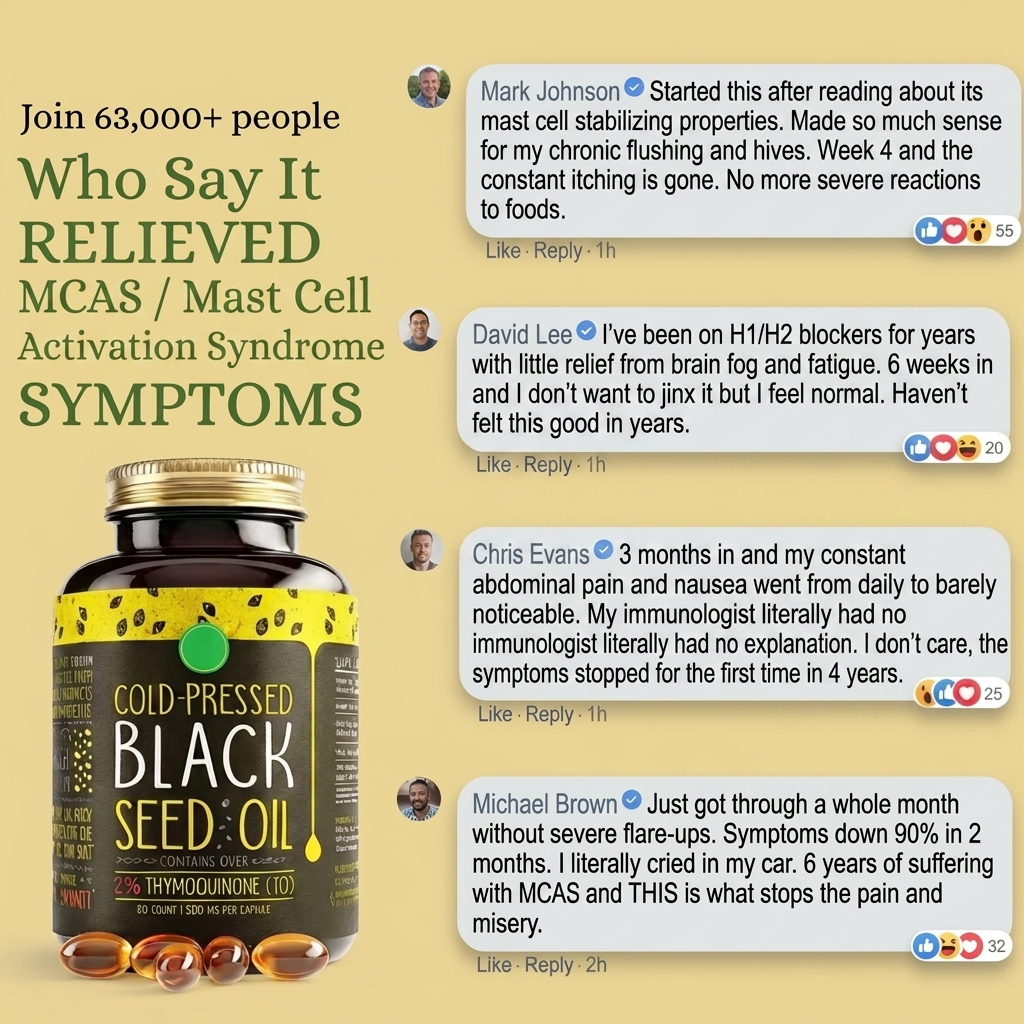
From the MCAS Community
On H1, H2, Cromolyn, Quercetin, and a 20-Food Diet. Still Flaring. Until This.
Real experiences from people managing mast cell activation who added high-TQ black seed oil to their existing protocol.
"I started with literally one drop mixed into applesauce because I react to everything. Waited 48 hours. Nothing. Added a second drop. By week 3 I was at half a teaspoon daily. The flushing decreased first. Then the brain fog started lifting — like a filter being slowly removed. By week 8 my food tolerance had expanded from about 18 safe foods to over 30. My MCAS specialist asked what I changed. I told her about the TQ concentration. She looked up the mechanism and added it to her recommendation list."
"I've had MCAS alongside EDS and POTS for six years. I'm on Zyrtec, Pepcid, cromolyn, quercetin phytosome, DAO with meals, and a strict low-histamine diet. I still had a constant low-level hum of symptoms — the itching, the bloating, the feeling of being slightly inflamed at all times. Added this at week 4 of the slow titration. The 'hum' quieted for the first time. Not gone. But quieter than it's been in years. That matters more than I can explain."
"Unbelievable difference in my asthma and MCAS. My lungs are genuinely better. I was using my rescue inhaler 3-4 times a week. I'm now at maybe once every two weeks. The nasal congestion that I thought was just 'how I breathe' has cleared. I didn't realize how much of my respiratory load was mast cell driven until something actually addressed the mast cells instead of just blocking the histamine after the damage was done."
Designed for Reactive Bodies
One ingredient. Cold-pressed. No fillers, dyes, or additives your mast cells will react to. Standardized to the concentration where the mast cell stabilizing mechanism becomes clinically relevant.
2% TQ Verified
Clinical-grade thymoquinone concentration. Below 2%, the mast cell stabilizing mechanism is below threshold. Third-party tested.
Start Low, Go Slow
Begin with one drop. Observe 48 hours. Increase gradually. We understand reactive bodies — and we built the dosing protocol for yours.
Stacks With Everything
Synergistic with H1/H2 blockers, cromolyn, ketotifen, quercetin, luteolin, and DAO. Complementary pathways, not competing ones.
$35 vs $150-500
Cromolyn runs $150-500/month. Compounded ketotifen $50-150. This addresses the same mechanism class at a fraction of the cost.
The Start-Low Protocol for Reactive Bodies
We know your body reacts to things other people tolerate without thinking. This protocol was designed for you — not for the general wellness customer. Change one variable at a time. Observe before increasing. Your mast cells set the pace, not a dosing chart.
Days 1-3: One single drop
Mix one drop into a small amount of food you know is safe. Observe for 24-48 hours. If no reaction, proceed.
Days 4-7: Two drops
Same method. Same observation window. If tolerated, continue increasing.
Week 2: Quarter teaspoon (1.25ml)
Take with food. You may begin to notice subtle shifts — slightly calmer baseline, marginally less reactive.
Week 3-4: Half teaspoon (2.5ml)
This is where many MCAS patients report the first noticeable reduction in flushing, brain fog, or food reactivity.
Week 5+: One teaspoon (5ml) once or twice daily
Full therapeutic dose. Published research used doses in this range. Continue alongside your existing stack.
Questions from the MCAS Community
Everything You Need to Know Before Adding This to Your Stack
Thymoquinone (TQ), the primary bioactive in black seed oil, inhibits mast cell degranulation through two published mechanisms: calcium channel inhibition (decreasing the intracellular calcium surge that triggers granule release) and protein kinase C inhibition. This is confirmed in peer-reviewed research indexed on PubMed. A 2024 Frontiers in Immunology review classified thymoquinone as a natural mast cell stabilizer. Beyond degranulation, TQ also reduces histamine release, inhibits leukotriene production via 5-lipoxygenase inhibition, calms IgE-mediated responses, and suppresses inflammatory cytokines TNF-α, IL-1, IL-4, IL-5, IL-6, and IL-13 through NF-κB suppression. These are the same mediator pathways that cromolyn, ketotifen, and montelukast target.
Yes — TQ is positioned as an addition to your existing stack, not a replacement for any part of it. It addresses complementary pathways: your H1 and H2 blockers address histamine receptors, your cromolyn stabilizes GI mast cells, your quercetin modulates some NF-κB pathways. TQ adds calcium channel-mediated degranulation inhibition, 5-LOX leukotriene reduction, and broader cytokine suppression that your current stack doesn't fully cover. MCAS-literate practitioners who recommend black seed oil position it alongside existing medications, not in place of them. Always confirm with your practitioner before adding.
Thymoquinone concentration varies enormously across products. Most commercial black seed oil contains less than 0.5% TQ. The published mast cell stabilizer research used standardized concentrations. Below 2% TQ, the mechanism — calcium channel inhibition, protein kinase C inhibition, cytokine suppression — is below the threshold where clinical effects become measurable. This product is third-party verified at 2% TQ. If you tried BSO before and noticed nothing, the most likely explanation is that the product was below clinical-grade concentration.
You might. We're honest about this because your trust matters more than a sale. A small minority of MCAS patients are paradoxically reactive to black seed oil itself, especially during severe flares. This is why the start-low protocol exists: one drop, mixed into a safe food, with 24-48 hours of observation before increasing. If you react, stop and try again when your baseline is calmer. If it isn't right for your body, the 90-day guarantee covers you — no questions asked. We'd rather you try safely than not try at all.
This is a legitimate concern that we take seriously. Some MCAS patients with confirmed salicylate intolerance have reported reacting to black seed oil. If salicylates are a known trigger for you, we recommend discussing with your MCAS practitioner before trying, and if you do try, starting at the absolute minimum dose (one drop) with extended observation. This may not be the right supplement for every MCAS patient — and we'd rather tell you that upfront than have you find out the hard way.
Transparency matters more than sales. Black seed oil can lower blood sugar (monitor if on diabetes medications), lower blood pressure (watch for dizziness if on antihypertensives), and has mild blood-thinning effects (do not start without medical supervision if on warfarin, apixaban, rivaroxaban, clopidogrel, or aspirin — stop 2 weeks before surgery). It can interact with cyclosporine (important for transplant patients). It mildly affects CYP3A4 — less than grapefruit, but worth knowing if you take medications metabolized through that pathway. Not recommended in medicinal doses during pregnancy. Always discuss with your prescribing physician.
They're complementary, not competing. Quercetin inhibits histidine decarboxylase (reducing histamine production at the source), stabilizes the mast cell membrane, and has some NF-κB modulation. TQ inhibits degranulation through calcium channel and PKC mechanisms, reduces leukotriene production via 5-LOX inhibition, and suppresses a broader cytokine panel (IL-4, IL-5, IL-13 in addition to TNF-α and IL-6). The published literature and MCAS-specialist practitioners recommend stacking quercetin and TQ because they hit the mast cell from different angles. Taking both covers more pathways than either one alone.
MCAS patients who introduce TQ carefully report a typical timeline: subtle reduction in baseline reactivity within 3-4 weeks, noticeable improvement in flushing, brain fog, or food tolerance by 6-8 weeks, and a broader sense of the immune system being "less reactive overall" by 3-4 months. Because the start-low titration takes 3-5 weeks to reach therapeutic dose, the full benefit window is approximately 8-12 weeks from first drop. This is why we offer a 90-day guarantee — you need the full titration + therapeutic window to evaluate properly.
90-day money-back guarantee. Specifically designed for the MCAS community because we know the start-low titration takes time and not every body will tolerate it. If you react, if it doesn't help, or if it's simply not right for you — full refund, no questions asked.
"I've had MCAS for five years. My stack is Zyrtec twice daily, Pepcid twice daily, cromolyn with every meal, quercetin phytosome, DAO before eating, and a 22-food diet. I was managing, not improving. Started with one drop of this, worked up over four weeks. The first thing I noticed was the flushing decreased. Then the brain fog started clearing — not completely, but enough that I could read a full article again without rereading every paragraph. By month three, I'd added six foods back to my safe list. My allergist said my tryptase levels had decreased. One compound didn't replace my stack. It completed it."

The Mast Cell Stabilizer Your Immunologist Wasn't Trained to Mention
Thymoquinone has been studied for over 20 years in peer-reviewed research for its effects on mast cells, histamine, allergic inflammation, and immune regulation. Published data includes randomized controlled trials in allergic rhinitis, asthma, eczema, and autoimmune conditions — all demonstrating meaningful symptom reduction through mast cell stabilization.
A Frontiers in Immunology review confirmed thymoquinone as a natural compound that "inhibits mast cell degranulation and decreases the number of mast cells." The mechanism — calcium channel inhibition and protein kinase C inhibition — is the same mechanism class used by the pharmaceutical mast cell stabilizers your immunologist prescribes. The difference: it wasn't in their training.
"Thymoquinone is one of the few natural compounds that touches mast cells, the immune system, the gut barrier, and inflammation all at once. When mast cells calm down, histamine drops, gut inflammation eases, brain fog lifts, skin settles, and the whole nervous system stops living in threat mode."
— MCAS Health Researcher, community post (400 likes in 10 hours)
Limited Stock Available
Calm the Cells. Not Just the Symptoms.
Cold-pressed Nigella sativa, standardized to 2% thymoquinone, third-party tested for purity and potency. One ingredient. No fillers. No dyes. No additives your mast cells will react to. Designed for the most reactive bodies. Delivered with a start-low-go-slow protocol and a 90-day guarantee because we know your body needs time to decide.
Shop NowQuieter Baselines. Fewer Flares.
Real people with mast cell activation. Real protocol. Real results.

"MCAS + long COVID. My mast cells went haywire after my second infection. Flushing, hives, food reactions to things I'd eaten my whole life. I was on Zyrtec, Pepcid, and quercetin — barely managing. Added this using the one-drop protocol. By week 6 the flushing episodes went from daily to maybe twice a week. By month 3 my food list expanded from 15 to 25+ items. The 2% TQ matters — I tried a cheaper BSO before with zero effect."

"I've been paying $420/month for cromolyn for three years. Added this at $35/month alongside it. Within 8 weeks my MCAS specialist and I were discussing whether I could reduce my cromolyn dose. I'm now on half the cromolyn I was on before, supplemented by this. My monthly medication cost dropped by over $150. Same symptom control. Different mechanism doing part of the work."

"I was terrified to try anything new because I react to EVERYTHING. Started with literally one drop. Nothing happened. Added another. Nothing. Worked up to half a teaspoon over three weeks. The first thing I noticed was sleeping through the night without the 3am histamine wake-up for the first time in two years. That alone was worth it. The skin calming came at week 5. I still have MCAS. I still manage triggers. But my baseline is lower than it's been since diagnosis."
*These statements have not been evaluated by the Food and Drug Administration. This product is not intended to diagnose, treat, cure, or prevent any disease. Results may vary from person to person. This product is not a replacement for prescribed MCAS medications including antihistamines, mast cell stabilizers, or leukotriene inhibitors. Consult your healthcare provider or MCAS-literate practitioner before starting any new supplement, especially if you are on blood thinners, blood pressure medication, diabetes medication, immunosuppressants, or are pregnant. Start with minimal doses and increase gradually. A small minority of individuals with mast cell activation may react to black seed oil — discontinue if a reaction occurs.